

Current Procedural Terminology (CPT): Complete Guide
Last Updated on: March 7, 2026
Reviewed by Kyle Wilson
- Licensed Agent
- @ verimedix
Current Procedural Terminology (CPT) is a standardized medical coding system used to report healthcare services and procedures. These codes are essential for billing, insurance claims, and revenue cycle management. Healthcare providers rely on CPT codes to ensure accurate documentation and reimbursement.
Understanding Current Procedural Terminology helps improve claim accuracy, reduce denials, and maintain compliance with payer guidelines. In this guide, we will explain CPT meaning, types, sections, common codes, and updates for 2026.
Get Free Quotes
Customized Options Await
What is Current Procedural Terminology?
Current Procedural Terminology is a medical code set used to describe medical, surgical, and diagnostic services. These codes ensure uniform communication between healthcare providers, insurance companies, and billing departments.
CPT codes are widely used in the United States for medical billing and documentation. They help standardize reporting and simplify reimbursement processes.
Who Publishes Current Procedural Terminology?
American Medical Association publishes and maintains the Current Procedural Terminology code set. The AMA updates the CPT code book annually to reflect new medical procedures, technology advancements, and regulatory changes.
The official CPT manual is released every year, including updated guidelines and revised codes for accurate billing practices.
History of Current Procedural Terminology
CPT was first introduced in 1966 to standardize reporting of medical procedures. Over time, it evolved into the primary coding system for outpatient and physician services.
With continuous updates, the CPT system now reflects modern healthcare practices, telemedicine services, and digital health advancements.
What Are CPT Codes?
CPT codes are five-digit numeric codes that represent medical services and procedures. These codes are used for billing insurance providers and documenting patient care.
There are three main categories of CPT codes that classify different types of services provided in healthcare settings.
The 3 Categories of CPT Codes
Category I Codes
These are the most commonly used CPT codes. They represent medical procedures, surgeries, evaluations, and diagnostic services.
Category II Codes
These are optional performance measurement codes used for quality reporting and tracking patient outcomes.
Category III Codes
These temporary codes are assigned to emerging technologies and experimental procedures.
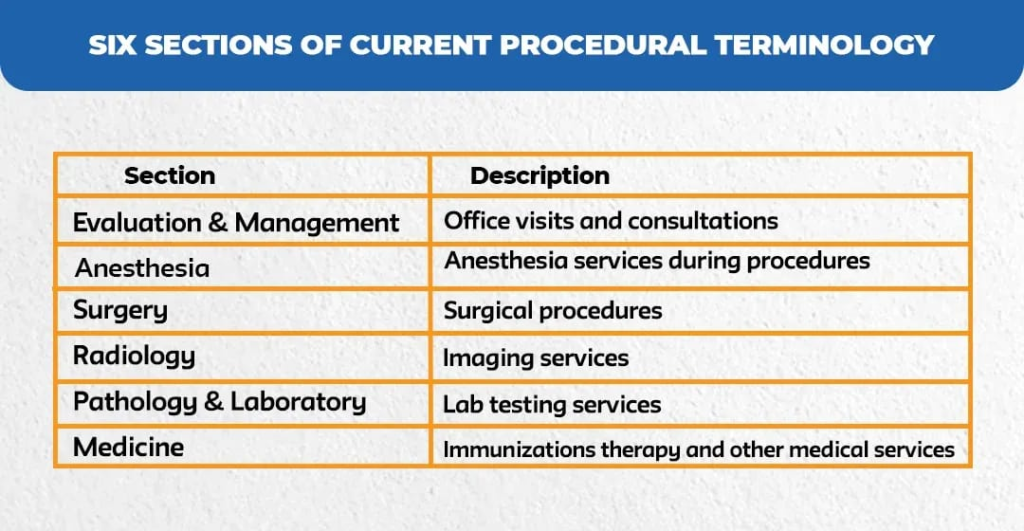
Six Sections of Current Procedural Terminology
CPT Category I codes are divided into six main sections:
Section | Description |
Evaluation & Management | Office visits and consultations |
Anesthesia | Anesthesia services during procedures |
Surgery | Surgical procedures |
Radiology | Imaging services |
Pathology & Laboratory | Lab testing services |
Medicine | Immunizations, therapy, and other medical services |
These sections help organize CPT codes efficiently for medical billing professionals.
5 Common CPT Codes
Below are some commonly used CPT codes in outpatient care:
CPT Code | Description |
99213 | Established patient office visit (moderate complexity) |
99214 | Established patient visit (higher complexity) |
93000 | Electrocardiogram (ECG) |
80053 | Comprehensive metabolic panel |
36415 | Routine venipuncture |
What is CPT Code 99213 and 99214?
CPT code 99213 is used for a moderate-level established patient office visit. It typically involves evaluation and management of stable conditions.
CPT code 99214 represents a more complex visit requiring detailed history, examination, and medical decision-making. These codes are among the most frequently billed services in outpatient settings.
Current Procedural Terminology 2026 Updates
The Current Procedural Terminology 2026 edition includes updates for telehealth, digital health services, and revised evaluation guidelines. Annual updates ensure that medical coding reflects advancements in healthcare practices.
Healthcare providers must stay updated with the latest CPT manual to maintain compliance and avoid billing errors.
Importance of CPT in Revenue Cycle Management
CPT codes play a critical role in accurate billing and reimbursement. Proper code selection reduces denials and ensures faster payments from insurance providers.
Incorrect coding can lead to claim rejections, audits, and financial losses. Therefore, training and regular CPT updates are essential for healthcare organizations.
Pros and Cons of Using CPT Codes
Pros
Advantages | Impact |
Standardized billing system | Reduces confusion between providers and payers |
Improves reimbursement accuracy | Faster claims processing |
Supports compliance | Reduces audit risk |
Updated annually | Reflects new medical procedures |
Cons
Challenges | Impact |
Complex coding rules | Requires professional training |
Frequent updates | Continuous education needed |
Coding errors risk | May lead to denials |
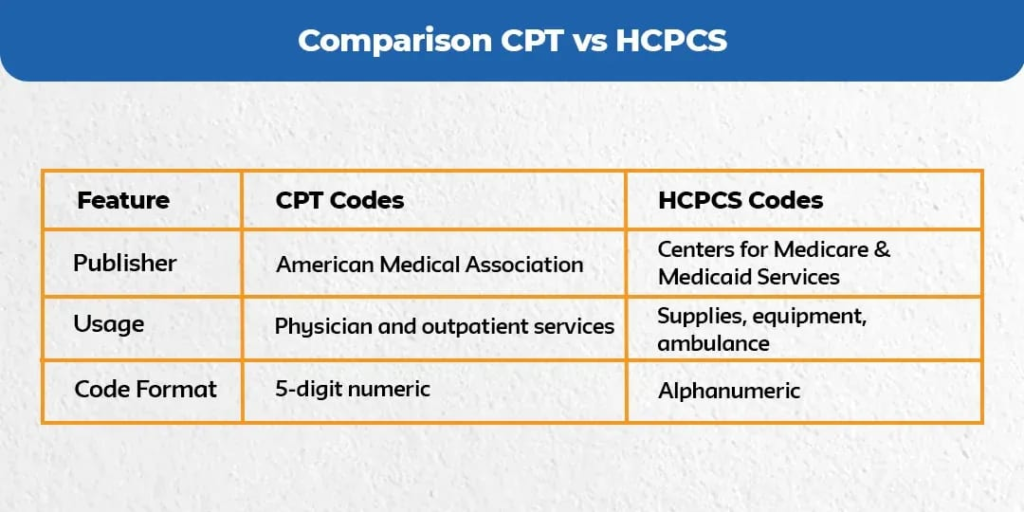
Comparison: CPT vs HCPCS
Feature | CPT Codes | HCPCS Codes |
Publisher | American Medical Association | Centers for Medicare & Medicaid Services |
Usage | Physician and outpatient services | Supplies, equipment, ambulance |
Code Format | 5-digit numeric | Alphanumeric |
Both systems work together to ensure complete medical billing documentation.
Conclusion
Current Procedural Terminology is a fundamental part of medical billing and healthcare documentation. From office visits to complex surgical procedures, CPT codes ensure standardized reporting and accurate reimbursement.
Staying updated with CPT 2026 changes, understanding code categories, and proper training can significantly improve billing accuracy and revenue performance. Healthcare organizations that prioritize coding accuracy reduce denials and maintain compliance.
Contact Verimedix today to streamline your coding process and strengthen your revenue cycle performance.
FAQs
It is a standardized medical coding system used to describe healthcare procedures and services for billing and documentation purposes.
Examples include 99213, 99214, 93000, 80053, and 36415.
The six main sections are Evaluation & Management, Anesthesia, Surgery, Radiology, Pathology & Laboratory, and Medicine.
These codes represent established patient office visits, with 99214 indicating a higher level of complexity than 99213.
There are six primary sections under Category I CPT codes.
THE AUTHOR
Shawn Davis is a leading expert in medical administration and revenue optimization. For years, Shown has been driving outstanding financial outcomes for healthcare providers through Denial Management, Eligibility Verification, Medical Billing and Coding, and Revenue Cycle Management. He is dedicated to helping practices streamline their operations and maximize their reimbursements through precision-driven digital solutions.