

Top 10 Revenue Cycle Management Trends for 2026
Last Updated on: February 26, 2026
Reviewed by Kyle Wilson
- Licensed Agent
- @ verimedix

Revenue Cycle Management is evolving rapidly as healthcare providers focus on improving efficiency, reducing denials, and accelerating reimbursements. In 2026, advanced technologies and strategic outsourcing are reshaping how healthcare organizations manage financial operations. Understanding these trends can help providers stay competitive and ensure long-term financial stability.
This guide explores the top Revenue Cycle Management trends that will transform healthcare in 2026.
Get Free Quotes
Customized Options Await
1.Artificial Intelligence in Revenue Cycle Management
AI continues to revolutionize healthcare billing by improving claim accuracy and predicting denials. Intelligent automation reduces manual work and improves efficiency. AI tools analyze large data sets to identify patterns, helping healthcare providers make smarter financial decisions and reduce administrative costs.
2. Automation of Billing and Coding Processes
Automation is becoming essential in managing repetitive tasks such as coding, eligibility checks, and claims submission. This trend helps reduce errors, increase productivity, and speed up reimbursements. Healthcare providers can streamline operations and focus more on patient care while maintaining compliance and accuracy.
3. Predictive Analytics for Revenue Optimization
Predictive analytics is helping organizations forecast revenue, identify risks, and optimize workflows. By using real-time data, providers can detect claim issues before submission. This proactive approach improves cash flow, minimizes denials, and enhances financial performance across the entire revenue cycle.
4. Cloud-Based RCM Solutions
Cloud-based systems offer flexibility, scalability, and remote accessibility. Healthcare organizations are moving away from traditional systems to improve data security and collaboration. Cloud platforms also enable seamless integration with EHR and practice management software, ensuring smoother workflows and better reporting.
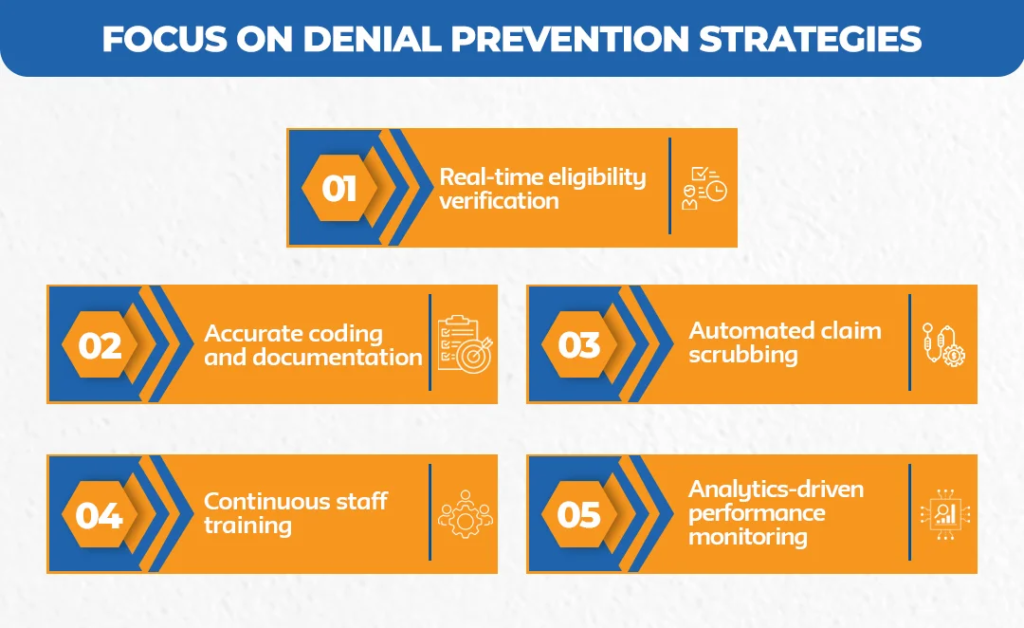
5. Focus on Denial Prevention Strategies
Denial management is shifting toward prevention rather than correction. Providers are implementing advanced tools to identify root causes and reduce rejection rates.
Key denial prevention strategies include:
- Real-time eligibility verification
- Accurate coding and documentation
- Automated claim scrubbing
- Continuous staff training
- Analytics-driven performance monitoring
These strategies help reduce revenue loss and improve operational efficiency.
6. Outsourcing Revenue Cycle Management
Outsourcing continues to grow as providers look for cost-effective solutions and expert support. Partnering with experienced RCM companies improves billing accuracy, compliance, and financial outcomes. Outsourcing also reduces administrative burden and allows providers to focus on patient care and organizational growth.
7. Patient-Centered Financial Experience
Healthcare organizations are prioritizing transparency and convenience in billing. Patients expect clear pricing, flexible payment plans, and digital communication. Improving the patient’s financial journey increases satisfaction, builds trust, and enhances revenue collection.
8. Advanced Data Security and Compliance
With increasing cyber threats, healthcare providers are strengthening data protection and compliance. Secure systems ensure patient privacy and protect sensitive financial information. Compliance with regulations such as HIPAA is essential for maintaining trust and avoiding legal risks.
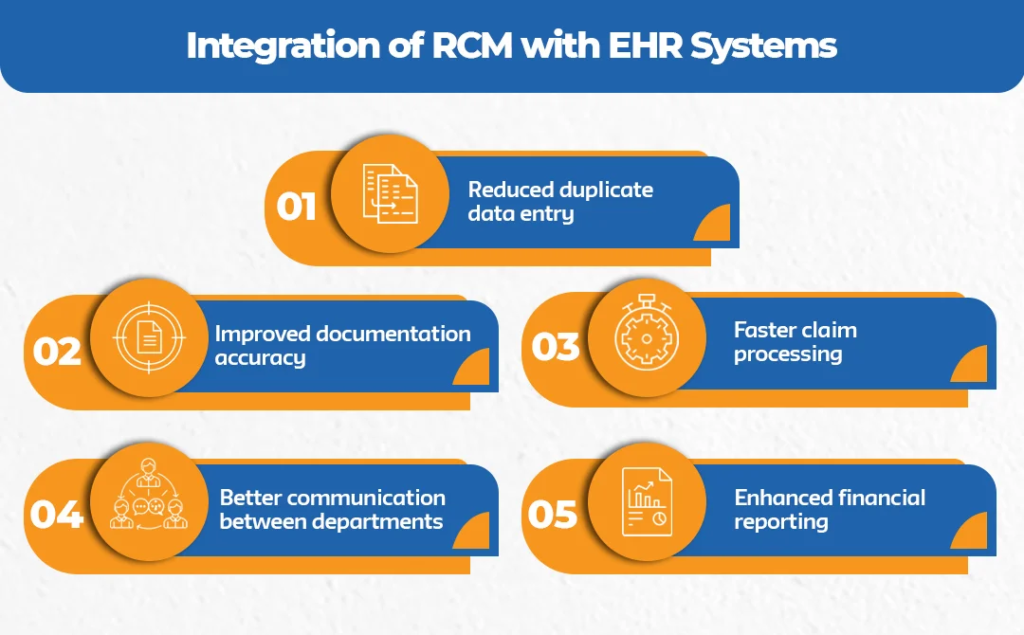
9. Integration of RCM with EHR Systems
Integration between revenue cycle and clinical systems improves accuracy and workflow efficiency.
Benefits of integration include:
- Reduced duplicate data entry
- Improved documentation accuracy
- Faster claim processing
- Better communication between departments
- Enhanced financial reporting
This seamless connectivity supports better decision-making and operational performance.
10. Value-Based Care and Financial Alignment
As healthcare shifts toward value-based care, RCM strategies are adapting to new reimbursement models. Providers must focus on quality outcomes, patient engagement, and cost management. Aligning financial processes with care delivery improves long-term sustainability and performance.
Pros and Cons of Revenue Cycle Management
Aspect | Pros | Cons |
Artificial Intelligence | Improves claim accuracy, predicts denials | Requires investment and skilled staff |
Automation | Reduces manual work and errors | Initial setup cost |
Predictive Analytics | Enhances revenue forecasting | Needs quality data |
Cloud-Based Systems | Flexible and scalable | Security concerns if poorly managed |
Outsourcing | Reduces workload and improves efficiency | Less direct control |
Integration with EHR | Better workflow and data accuracy | Complex implementation |
Patient-Centered Billing | Improves satisfaction and collections | Requires digital tools |
Compliance and Security | Protects sensitive data | Continuous monitoring needed |
Value-Based Care | Supports long-term sustainability | Complex reimbursement models |
Challenges of Revenue Cycle Management Innovations
Despite the benefits, adopting new RCM trends may involve high implementation costs and staff training. Technology integration can also create temporary workflow disruptions.
Healthcare providers must ensure data security, regulatory compliance, and system compatibility. Without proper planning, these challenges can reduce efficiency and delay expected results.
Comparison: Traditional vs Modern Revenue Cycle Management
Feature | Traditional RCM | Modern RCM |
Technology | Manual and paper-based | AI and automation-driven |
Efficiency | Slower processes | Faster and streamlined |
Error Rate | High manual errors | Lower with automation |
Data Insights | Limited reporting | Real-time analytics |
Patient Experience | Basic billing | Transparent and digital |
Cost | High administrative cost | Long-term cost savings |
Compliance | Manual monitoring | Automated compliance tracking |
Scalability | Limited growth | Easily scalable |
Conclusion
Revenue Cycle Management in 2026 is driven by innovation, automation, and patient-focused strategies. Healthcare providers that adopt AI, predictive analytics, cloud solutions, and outsourcing will gain a competitive advantage. By improving efficiency and reducing denials, organizations can achieve stronger financial performance and better patient outcomes.
Staying updated with these trends allows providers to optimize operations and secure long-term growth in an evolving healthcare landscape.
Ready to Improve Your Healthcare Revenue Cycle?
Contact Verimedix today and transform your RCM process with expert solutions designed to reduce denials, accelerate reimbursements, and boost your financial performance. Our dedicated team ensures accurate billing, compliance, and end-to-end revenue cycle support, so you can focus on delivering high-quality patient care.
FAQs
What are the trends in RCM?
The main trends include AI automation, cloud-based systems, predictive analytics, outsourcing, and patient-centered billing strategies.
What are the 10 steps in the revenue cycle?
The steps include patient registration, eligibility verification, coding, claims submission, payment posting, denial management, and reporting.
What are the four P’s of revenue cycle management?
The four P’s include people, process, performance, and technology.
What are the 7 steps of revenue cycle management?
These steps involve scheduling, insurance verification, documentation, coding, billing, collections, and analytics.
What are the 9 steps in RCM?
The 9 steps expand the traditional cycle with patient engagement, compliance, and revenue optimization processes.
THE AUTHOR
Shawn Davis is a leading expert in medical administration and revenue optimization. For years, Shown has been driving outstanding financial outcomes for healthcare providers through Denial Management, Eligibility Verification, Medical Billing and Coding, and Revenue Cycle Management. He is dedicated to helping practices streamline their operations and maximize their reimbursements through precision-driven digital solutions.