

What Is a J-Code in Medical Billing?
Last Updated on: March 24, 2026
Reviewed by Kyle Wilson
- Licensed Agent
- @ verimedix

Medical billing is a complex system filled with different coding structures, and one of the most important yet misunderstood categories is the J-code in medical billing. These codes play a critical role in billing for medications administered in clinical settings, especially injectables and infusions.
Whether you’re a healthcare provider, billing specialist, or medical practice owner, understanding J-codes is essential for accurate claims submission, compliance, and maximizing reimbursement. In this complete guide, we’ll explain what J-codes are, how they work, their relationship with HCPCS codes, and how to avoid common billing errors.
Get Free Quotes
Customized Options Await
What Is a J-Code in Medical Billing?
A J-code in medical billing is a specific type of code used to identify drugs and medications that are administered by healthcare professionals, rather than taken by patients at home. These codes are part of the Healthcare Common Procedure Coding System (HCPCS) Level II.
J-codes are primarily used to bill for:
- Injectable medications
- Intravenous (IV) drugs
- Chemotherapy agents
- Biological drugs
- Infusion therapies
Each J-code begins with the letter “J” followed by four digits (for example, J1885 or J1100), making them easy to identify in medical claims.
What Is J-Code in Medical Coding?
In medical coding, J-codes are used to translate administered medications into standardized codes that insurance companies understand. These codes ensure that healthcare providers are reimbursed accurately for the drugs they provide during treatment.
Unlike oral medications, which are often billed using pharmacy systems, J-codes specifically apply to non-oral medications given in clinical settings, such as hospitals, outpatient centers, or physician offices.
What Does Code “J” Represent?
The letter “J” in J-codes generally represents injectable drugs and non-oral medications. While commonly associated with injections, J-codes actually cover a broader range of treatments, including:
- Intramuscular injections
- Intravenous infusions
- Chemotherapy drugs
- Immunotherapy and biologics
These medications typically require:
- Professional administration
- Sterile preparation
- Patient monitoring
What CPT Codes Start With J?
This is a common point of confusion.
CPT codes do NOT start with “J.”
Instead:
- J-codes belong to HCPCS Level II, not CPT
- CPT codes describe procedures and services
- J-codes describe medications and drugs
For example:
- CPT Code → Injection procedure
- J-Code → Drug used in that injection
Understanding this distinction is critical for accurate billing and avoiding claim denials.
Is the J-Code the Same as HCPCS?
J-codes are not the same as HCPCS, but they are a subset of HCPCS Level II codes.
Breakdown:
- HCPCS Level I → CPT codes (procedures)
- HCPCS Level II → Supplies, equipment, and drugs
- J-Codes → Drug-specific codes within HCPCS Level II
This means all J-codes are HCPCS codes, but not all HCPCS codes are J-codes.
Why Are J-Codes Important in Medical Billing?
J-codes are essential for healthcare providers because they:
- Ensure accurate reimbursement for medications
- Provide standardized drug identification
- Reduce billing confusion
- Support compliance with Medicare and insurance guidelines
Incorrect use of J-codes can lead to:
- Claim denials
- Payment delays
- Revenue loss
- Compliance risks
Types of Drugs Covered by J-Codes
J-codes cover a wide range of medications, including:
1. Injectable Drugs
- Pain medications
- Antibiotics
- Steroids
2. Chemotherapy Drugs
- Cancer treatment medications
- Specialty oncology drugs
3. Biologicals
- Vaccines
- Immunotherapy agents
4. Infusion Therapies
- IV fluids
- Specialty infusions
These drugs are typically administered in clinical settings under professional supervision.
Examples of J-Codes
Here are some real-world examples of J-codes:
- J1100 – Dexamethasone injection
- J1885 – Ketorolac injection
- J0171 – Epinephrine injection
- J3490 – Unclassified drugs
Each code represents a specific drug and dosage, which helps insurers determine reimbursement accurately.
How J-Codes Work in Billing
J-codes provide detailed information about the medication used, including:
- Drug name
- Dosage
- Route of administration
- Quantity administered
Healthcare providers include J-codes in claims submitted to:
- Medicare
- Medicaid
- Private insurance companies
This ensures that payers understand exactly what medication was administered and how much should be reimbursed.
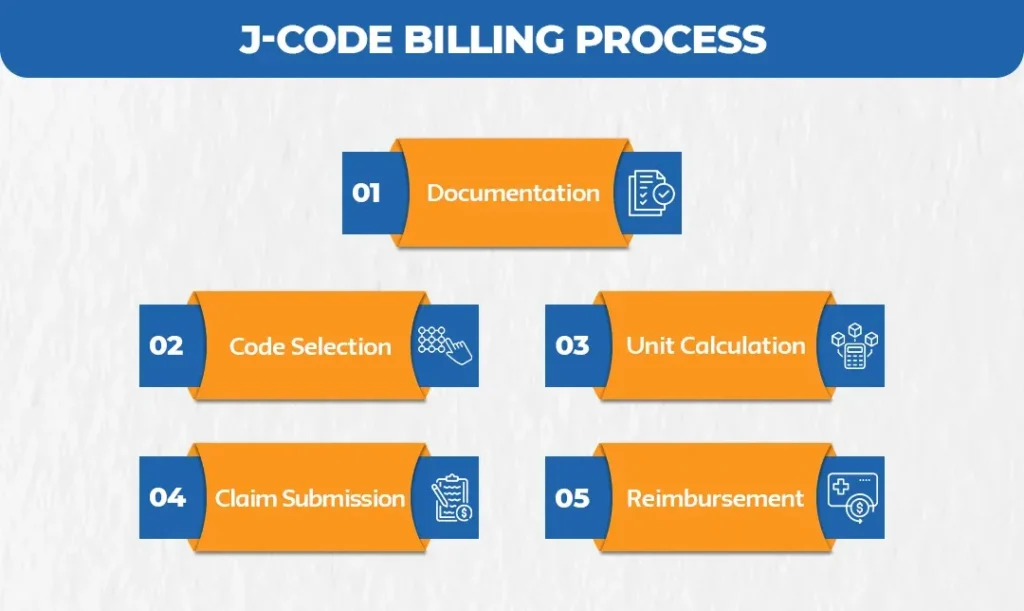
J-Code Billing Process
The J-code billing process involves several steps:
1. Documentation
Physician documents the drug administered, dosage, and method.
2. Code Selection
Billing specialist assigns the correct J-code.
3. Unit Calculation
Each J-code has a specific unit measurement (e.g., per mg).
4. Claim Submission
Submit a claim with J-code and supporting documentation.
5. Reimbursement
Insurance reviews the claim and processes payment.
Common J-Code Billing Errors
Incorrect J-code usage can lead to claim denials. Common errors include:
- Wrong code selection
- Incorrect unit calculation
- Missing documentation
- Failure to include NDC numbers
- Using unclassified codes without details
Unclassified codes like J3490 often require additional documentation, which can delay reimbursement.
J-Codes vs Other Medical Codes
Understanding how J-codes compare to other codes is essential:
Code Type | Purpose |
ICD-10 | Diagnosis codes |
CPT | Procedures and services |
HCPCS Level II | Supplies and equipment |
J-Codes | Injectable drugs |
Each code plays a different role in the medical billing process.
J-Codes and Medicare Billing
J-codes are heavily used in Medicare billing, especially for outpatient services.
To bill correctly:
- Use accurate J-codes
- Include proper documentation
- Follow Medicare fee schedules
- Ensure medical necessity
Failure to comply with Medicare guidelines can result in audits or denied claims.
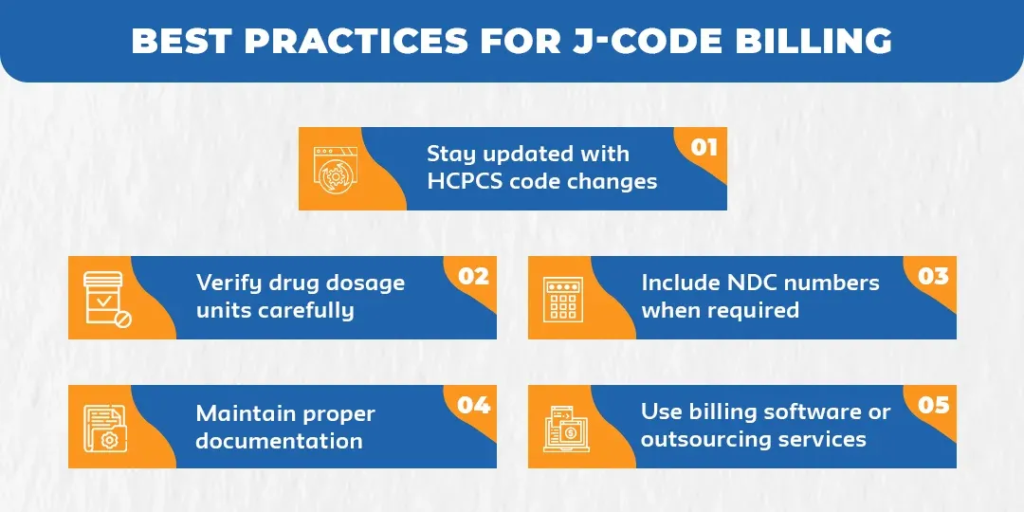
Best Practices for J-Code Billing
To optimize billing accuracy and reimbursement:
- Stay updated with HCPCS code changes
- Verify drug dosage units carefully
- Include NDC numbers when required
- Maintain proper documentation
- Use billing software or outsourcing services
How Verimedix Helps with J-Code Billing
Managing J-code billing can be complex, but Verimedix simplifies the process with expert solutions:
Services Include:
- Accurate J-code assignment
- Claims submission and tracking
- Denial management and appeals
- Compliance monitoring
- Revenue cycle optimization
With Verimedix, healthcare providers can reduce errors, improve reimbursement rates, and focus on patient care.
Simplify Your Medical Billing with Verimedix
Struggling with J-code billing, claim denials, or compliance issues? Let Verimedix handle your medical billing needs with precision and expertise.
With our advanced billing solutions, you can:
- Reduce claim errors and denials
- Improve reimbursement rates
- Ensure full compliance with Medicare and insurance guidelines
- Streamline your revenue cycle
Visit Verimedix today and optimize your medical billing process with expert support.
FAQs
J-codes are HCPCS Level II codes used to identify drugs administered by healthcare professionals, such as injections and infusions.
Code “J” represents injectable and non-oral medications used in clinical settings.
None. J-codes are part of HCPCS Level II, not CPT codes.
J-codes are a subset of HCPCS Level II codes, specifically used for medications.
They ensure accurate billing and reimbursement for administered drugs.
Incorrect coding, missing documentation, and wrong unit calculations are common issues.
THE AUTHOR
Shawn Davis is a leading expert in medical administration and revenue optimization. For years, Shawn has been driving outstanding financial outcomes for healthcare providers through Denial Management, Eligibility Verification, Medical Billing and Coding, and Revenue Cycle Management. He is dedicated to helping practices streamline their operations and maximize their reimbursements through precision-driven digital solutions.